
Mental model
Section titled “Mental model”A startup is “a human institution designed to create a new product or service under conditions of extreme uncertainty” — the uncertainty is what defines it, not the size, the age, or the garage. Under that uncertainty a detailed plan is theatre, because you cannot forecast a market that does not exist yet. So the unit of progress stops being features shipped and becomes validated learning about customers, and every practice below is machinery for buying that learning cheaply.
Hypotheses, not ideas
Section titled “Hypotheses, not ideas”| Leap-of-faith assumption | The question it settles |
|---|---|
| Value hypothesis | Does this deliver value once used? |
| Growth hypothesis | How do new customers find it? |
| Customer segment | Who has this problem badly? |
| Willingness to pay | Will they give up money or time? |
Steve Blank puts the correction bluntly: “new ventures don’t start with ‘ideas’, they start with hypotheses (a fancy word for guesses)”. His frame for a startup is a temporary organization searching for a repeatable and scalable business model, and customer development is “the process of how you get out of the building and search for the model”. Write down the two assumptions that kill the company if they are wrong, and test those first — not the ones that are easiest to test.
Gotcha: Interest is not evidence. “Would you use this?” is answered by politeness, and everyone says yes. Ask what they did last time they had the problem, or ask for a commitment — an email, a deposit, an hour of their time.
Build-Measure-Learn
Section titled “Build-Measure-Learn”| Stage | Produces |
|---|---|
| Build | The smallest test of one hypothesis |
| Measure | Data on what people actually did |
| Learn | A pivot-or-persevere decision |
The loop runs build, then measure, then learn — but it is planned in reverse: decide what you need to learn, derive the metric that would show it, then build the least thing that produces that metric. The number to optimize is total time around the loop, not the speed of any one arc. Blank’s summary of the intent is “to maximize learning through incremental and iterative engineering”, which he restates as hypotheses, experiments, tests, insights.
Plan backwards        Run forwards  Learn what?           Build  Measure what?   ->    Measure  Build what?           Learn
Optimize the whole lap, not one arc.
Gotcha: Teams instrument the Build arc alone — velocity, cycle time, deploys per day — and leave a two-week reporting lag in Measure and a quarterly review in Learn. Halving build time then barely moves the loop it was supposed to shorten.
Minimum viable product
Section titled “Minimum viable product”| MVP type | What it tests |
|---|---|
| Landing page, ad smoke test | Demand, before anything exists |
| Concierge | The service, delivered by hand |
| Wizard of Oz | Real interface, manual behind it |
| Video | Whether people grasp and want it |
| Single-feature build | Value of the one core action |
The MVP is “that version of a new product which allows a team to collect the maximum amount of validated learning about customers with the least effort”, and Ries is emphatic that “MVP, despite the name, is not about creating minimal products”. Minimum is measured against the hypothesis, not against a feature count — IMVU’s first MVP took six months. Blank’s version is the useful test in the room: the simplest thing you can show customers to get the most learning at that point in time.
Gotcha: An MVP that produces no measurement is not an MVP, it is just a small product. Ries’s own example is a feature that took two weeks to build when “a simple AdWords smoke test would have revealed how utterly bad the concept was”.
Validated learning
Section titled “Validated learning”| Activity | Progress? |
|---|---|
| Feature shipped on schedule | Only if it settled a hypothesis |
| Hypothesis disproved by data | Yes — a costly path closed early |
| Revenue up, cause unknown | No, nothing was learned |
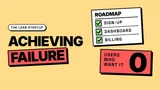
| Roadmap delivered in full | This is how you achieve failure |
Validated learning is “a rigorous method for demonstrating progress when one is embedded in the soil of extreme uncertainty”, and the validation “comes in the form of data that demonstrates that the key risks in the business have been addressed”. Ries states the priority plainly: “Given a choice between what a successful team has learned and the source code they have produced, I would take the learning every time.” The failure mode all of this exists to prevent is achieving failure — executing a plan faithfully, on time, on budget, for a product nobody wants.
Gotcha: A disproved hypothesis is a successful experiment, but it reads to the organization as a missed commitment. If the review only rewards shipped scope, teams will stop running experiments that can come back negative — which is all the useful ones.
Actionable metrics
Section titled “Actionable metrics”| Vanity metric | Actionable replacement |
|---|---|
| Total registered users | Activation rate, by cohort |
| Page views | Retention by signup week |
| Gross revenue | Revenue per customer, per cohort |
| Press mentions | Conversion from that channel |
Vanity metrics are “numbers which look good on paper but aren’t action oriented: website hits, message volume, or ‘billions and billions served’”. They only go up and to the right, so they cannot tell you whether the last change helped. Ries asks that every metric be actionable, accessible, and auditable, and that cause and effect be established by cohort analysis and split testing rather than by reading a cumulative chart.
Gotcha: Gross numbers invite a bias Ries names directly — “when the numbers go up, we tend to take credit. But when the numbers go down, we tend to blame someone or something else.” A per-cohort rate removes the argument, because each cohort’s curve stands alone.
Innovation accounting
Section titled “Innovation accounting”| Milestone | The work |
|---|---|
| Establish the baseline | Ship an MVP, measure where you are |
| Tune the engine | Move that baseline toward the ideal |
| Pivot or persevere | Judge whether tuning still pays |
Conventional milestones assume you know the destination, and a startup’s metrics are all effectively zero at the start — so innovation accounting substitutes learning milestones: how to measure progress and prioritize work while the business model is still a guess. The baseline is deliberately unflattering, being the honest current conversion, retention, or price. Tuning means every experiment must move that number, and the size of the moves tells you whether the hypothesis has life in it.
Gotcha: A team that keeps hitting small improvements can still be failing. If a dozen experiments each add a fraction of a percent and the gap to a viable business is a factor of ten, the engine is tuned and the hypothesis is still wrong.
Engines of growth
Section titled “Engines of growth”| Engine | The number that governs it |
|---|---|
| Sticky | Retention above churn rate |
| Viral | Viral coefficient above 1.0 |
| Paid | Lifetime value above blended CPA |
Growth is not a mood; it is one of three mechanisms, each with a single governing number. Sticky growth compounds when new customer acquisition outruns churn. Viral growth needs a coefficient above 1.0, because “if the coefficient is > 1.0, you generally have a viral hit on your hands”. Paid growth lives on the spread, which “determines either your profitability or your rate of growth”. Ries’s instruction is to specialize: “Every startup needs to ‘pick a major’ among these three drivers of growth. It’s simply too hard to focus on more than one.”
Gotcha: Word of mouth is not the viral engine. Viral means transmission is a necessary byproduct of ordinary use, the way sending mail once carried Hotmail’s signature — happy customers recommending you is sticky growth wearing a flattering name.
Pivot or persevere
Section titled “Pivot or persevere”| Pivot | What changes |
|---|---|
| Zoom-in | One feature becomes the whole product |
| Zoom-out | The product becomes one feature |
| Customer segment | Same product, a different buyer |
| Customer need | Same buyer, a different problem |
| Platform | Application becomes platform, or back |
| Engine of growth | Sticky, viral or paid is swapped |
A pivot is “a structural course correction to test a new fundamental hypothesis about the product, strategy and engine of growth” — the vision usually survives it, the strategy does not. What separates a pivot from a restart is continuity: “successful startups change directions but stay grounded in what they’ve learned. They keep one foot in the past and place one foot in a new possible future”, where unsuccessful ones “jump outright from one vision to something completely different” and discard the learning they paid for. Value capture, channel, technology and business architecture pivots complete the book’s catalogue. Schedule the decision as a standing meeting, so it is taken on evidence rather than on exhaustion.
Gotcha: Runway measured in months is the wrong unit — the real question is how many pivots you can still afford. Cutting burn buys more of both, but shortening the loop increases the runway without additional cash, which is the cheaper lever.
Small batches and Five Whys
Section titled “Small batches and Five Whys”| Practice | Effect |
|---|---|
| Small batches | Defect found next to its cause |
| Continuous deployment | The loop closes in hours |
| Five Whys | The fix lands on the cause |
| Proportional investment | Response sized to the damage |
The method inherits its factory floor from lean manufacturing: work in small batches, stop the line when something is wrong, and treat unused inventory — features nobody asked for — as waste. Five Whys is the tool for the stop: ask why five times, on the premise that behind every supposedly technical problem is a human problem, and always include “why didn’t our tests catch and prevent the problem?”. Then invest at every level in proportion to the damage — “don’t do too much, and don’t do nothing” — with everyone affected in the room.
Gotcha: Five Whys turns into five blames the moment a name arrives before a system does. Ries offers no shortcut — “there’s no easy fix to this problem. Trust takes time to build up” — so start with small problems and let the practice earn its credibility.
Further reading
Section titled “Further reading”A version typeset for e-ink is available at https://sokurenko.dev/foundations/lean-startup/