
Mental model
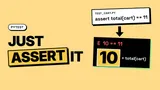
Section titled “Mental model”A pytest test is a plain function whose name starts with test, and
a failing assert is the whole reporting mechanism — pytest rewrites
the assert at import time so the failure shows every intermediate
value. Everything a test needs (data, clients, temp dirs, patches) is
a fixture: you ask for it by naming it as a parameter, and pytest
builds it, shares it for its scope, and tears it down afterwards.
Writing tests
Section titled “Writing tests”| Collected | Rule |
|---|---|
| Files | test_*.py or *_test.py |
| Functions | test prefix, at module level |
| Classes | Test prefix, no __init__ |
| Methods | test prefix inside a Test class |
Collection starts from testpaths (if configured) or the current
directory. No base class and no self.assertEqual — a bare assert
is enough, and pytest prints the operands when it fails.
def total(items):    return sum(p * q for p, q in items)
def test_total():    assert total([(2, 3), (5, 1)]) == 11
class TestEmpty:    def test_zero(self):        assert total([]) == 0
Gotcha: Assert rewriting applies only to test modules,
conftest.pyand plugins. Anassertinside a helper module fails with a bareAssertionErrorand no detail — callpytest.register_assert_rewrite("helpers")in the rootconftest.pybefore importing it.
Running and selecting
Section titled “Running and selecting”| Command | Effect |
|---|---|
pytest test_a.py::test_x | One test, by node ID |
pytest -k "cart and not slow" | Match names and markers |
pytest -x / --maxfail=3 | Stop at first / third failure |
pytest --lf / --ff | Rerun last failures / run them first |
pytest -s | Show print output (no capture) |
pytest -ra --durations=5 | Why things skipped; slowest five |
A node ID is path::Class::test[param], exactly as printed in the
report, so you can copy it from a failure line. Add --pdb to drop
into the debugger at the failing line. -q and -v adjust detail.
pytest -x --lf -qpytest "tests/test_cart.py::test_total"pytest -m "not slow" -n auto # -n needs xdistGotcha: Exit code
5means no tests were collected, and CI treats it as a failure. A typo intestpaths, or a file namedcart_tests.py(the pattern is*_test.py), lands you there.
Exceptions, warnings and floats
Section titled “Exceptions, warnings and floats”| Helper | Checks |
|---|---|
pytest.raises(E, match=r"...") | Block raises E; message regex |
pytest.warns(W) | Block emits warning W |
x == pytest.approx(y) | Float equal within tolerance |
match is applied with re.search, so a substring works but regex
metacharacters such as ( or . need escaping. The context manager
returns an ExceptionInfo; its .value is the raised exception.
import pytest
def test_bad_qty():    with pytest.raises(        ValueError, match="invalid literal"    ) as e:        int("qty")    assert "'qty'" in str(e.value)
def test_float():    assert 0.1 + 0.2 == pytest.approx(0.3)
Gotcha: Any line after the raising call inside the
withblock never runs. Keep only the call that should raise inside it, and put follow-up asserts after the block.
Fixtures
Section titled “Fixtures”| Form | Meaning |
|---|---|
@pytest.fixture | Declares a fixture |
def test_x(db): | Requests the fixture db |
return value | Provides the value, no teardown |
yield value | Code after yield is teardown |
A fixture can request other fixtures the same way tests do. Within one test each fixture runs once, however many times it is requested, so a shared dependency is built only once.
import pytest
@pytest.fixturedef db():    conn = {"open": True}    yield conn             # test runs here    conn["open"] = False   # teardown
@pytest.fixturedef user(db):    db["user"] = "ada"    return "ada"
def test_user(db, user):    assert db["user"] == user
Gotcha: Teardown after
yieldruns even when the test fails, but not when the fixture itself raises before theyield. Put the risky setup step first so nothing is left half-created.
Scope, conftest.py and autouse
Section titled “Scope, conftest.py and autouse”scope= | Built once per |
|---|---|
"function" (default) | Test |
"class" / "module" | Class / test file |
"package" | Directory package |
"session" | Whole run |
Fixtures in a conftest.py are visible to every test in that
directory and below, with no import. autouse=True applies a fixture
to every test in its reach without being requested — useful for
resetting global state, dangerous for anything expensive.
import pytest
@pytest.fixture(scope="session")def config():    return {"api": "http://test"}
@pytest.fixture(autouse=True)def reset_cache():    yield    # clear module-level caches here
Gotcha: A fixture may only request fixtures of the same or a wider scope. A
sessionfixture that asks for a function-scoped one (includingtmp_pathormonkeypatch) fails withScopeMismatch— usetmp_path_factoryinstead.
Parametrize
Section titled “Parametrize”| Form | Use |
|---|---|
parametrize("a,b", [(1, 2)]) | Run once per tuple |
ids=["small"] | Readable test IDs (keyword-only) |
pytest.param(..., marks=m) | Mark a single case |
| Stack two decorators | Cartesian product |
Each case becomes its own test with its own node ID, so failures are
reported — and rerun with --lf — individually. When the cases are
only known at run time, use the subtests fixture (pytest 9.0+):
with subtests.test(i=i): reports each block separately.
import pytest
@pytest.mark.parametrize(    "raw, want",    [        ("1", 1),        (" 2 ", 2),        pytest.param(            "x", None, marks=pytest.mark.xfail        ),    ],    ids=["plain", "spaces", "junk"],)def test_parse(raw, want):    assert int(raw) == want
Gotcha: Since pytest 9.2,
ids,indirectandscopeare keyword-only.parametrize("a", "b", [...])now raisesTypeError— wrap multiple names in one string:"a, b".
Markers: skip, xfail, custom
Section titled “Markers: skip, xfail, custom”| Marker | Effect |
|---|---|
skip(reason=...) | Never runs |
skipif(cond, reason=...) | Skips when cond is true |
xfail(strict=True) | Expected failure; a pass fails the run |
@pytest.mark.slow | Custom tag, select with -m slow |
Register custom markers in config so typos are caught. The -m flag
takes a boolean expression over marker names, such as
-m "slow and not db".
import sysimport pytest
@pytest.mark.skipif(    sys.platform == "win32", reason="POSIX")def test_root():    assert "/".startswith("/")
@pytest.mark.slowdef test_report():    assert sum(range(10**6)) > 0
Warning: Without
strict_markers, a misspelled marker such as@pytest.mark.slwoonly warns, and-m "not slow"silently runs the test. Enablestrict = true(below) to make it an error.
Built-in fixtures
Section titled “Built-in fixtures”| Fixture | Gives you |
|---|---|
tmp_path | Fresh pathlib.Path directory per test |
monkeypatch | Patch attrs, env, dict items; auto-undone |
capsys | Captured stdout / stderr |
caplog | Captured logging records |
All of these clean up after the test on their own: patches are
reverted and environment variables restored. Run
pytest --fixtures to list every fixture available in a directory.
import os
def greet():    print("hi", os.environ["USER_NAME"])
def test_greet(monkeypatch, capsys, tmp_path):    monkeypatch.setenv("USER_NAME", "ada")    greet()    assert capsys.readouterr().out == "hi ada\n"    (tmp_path / "a.txt").write_text("x")    assert (tmp_path / "a.txt").exists()
Gotcha: Patch the name where it is looked up, not where it is defined. After
from pay import charge, the moduleshopholds its owncharge— patchshop.charge, notpay.charge.
Configuration and plugins
Section titled “Configuration and plugins”| File | Table |
|---|---|
pytest.toml (9.0+) | [pytest] — native TOML types |
pyproject.toml | [tool.pytest] (9.0+, native types) |
pyproject.toml | [tool.pytest.ini_options] (strings) |
pytest.ini | [pytest] |
strict = true turns on strict_config, strict_markers,
strict_parametrization_ids and strict_xfail — and any strictness
option added later, so pin pytest when you use it. The docs recommend
--import-mode=importlib for new projects.
[tool.pytest]minversion = "9.0"testpaths = ["tests"]addopts = ["-ra", "--import-mode=importlib"]strict = truemarkers = ["slow: long-running tests"]Plugins add what core leaves out: pytest-xdist (-n auto),
pytest-cov (--cov), pytest-asyncio (async def tests).
Gotcha: pytest reads exactly one config file. With both a
pytest.iniand a[tool.pytest]table, the.iniwins and the TOML is ignored — pytest 9 at least prints a warning now.
Further reading
Section titled “Further reading”A version typeset for e-ink is available at https://sokurenko.dev/tooling/pytest/